Reliance on Spreadsheets & Paper
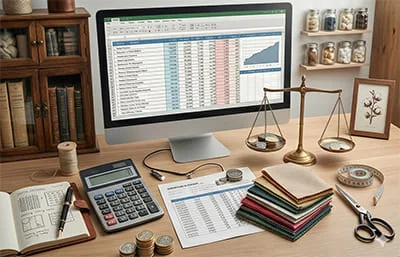
Many businesses still depend on spreadsheets, paper forms, and manual approvals. Employees waste time repeatedly transferring the same information between separate files.
A Software Development Company in Bangladesh should do more than deliver a set of features. The right software should solve operational problems, reduce repetitive work, organize business data, support better decisions and remain practical as the organization grows.
Instead of forcing every organization into the same ready-made system, the software scope should be planned around the company’s real processes, departments, and future expansion.
Many businesses still depend on spreadsheets, paper forms, and manual approvals. Employees waste time repeatedly transferring the same information between separate files.
When sales, purchasing, inventory, and accounting use different systems, it becomes difficult to understand what is happening across departments and reconcile information.
Standard software often adds unnecessary functionality that increases complexity without solving actual business problems, making routine tasks harder for employees.
As an organization expands, old systems struggle to support more users, additional branches, larger databases, or more complex permissions.
Simply storing data does not automatically make it useful. Without proper validation and structured management dashboards, decision-makers lack clear operational indicators.
Different employees require different access. Giving everyone access to every module creates confusion and risks data security and operational control.
Professional software development should begin with the business process rather than the technology. Whether replacing spreadsheets or developing a specialized operational system, the objective is the same: build software that fits the real workflow.
The first step is understanding the problem. We identify involved departments, current processes, user roles, pain points, and integration needs based on real operations.
Once requirements are clear, the project is divided into modules, workflows, and priorities. We determine which departments create data and which approve it.
Architecture considers realistic future requirements like additional users or branches. Scalability means avoiding design decisions that make future growth difficult.
Business software should make routine tasks easy. Screens, forms, menus, and dashboards follow a logical workflow instead of forcing employees through unnecessary steps.
Development converts approved requirements into working modules and system logic. Large projects may be delivered in phases for critical workflow review.
If the system needs external APIs or legacy information, integration and migration requirements are tested carefully to ensure data quality.
Testing covers both technical functions and real business scenarios, including user permissions, business rules, calculations, reports, and data validation.
The software is deployed according to the agreed environment (Cloud or On-Premise). Employees receive training on normal workflows and their responsibilities.
Business requirements change. Software is treated as an evolving operational system with ongoing support for updates, new reports, and future customization.
Build software that replaces spreadsheets, structures disjointed processes, and manages role-based operational data seamlessly across multiple departments.
Rather than treating every requirement as one large generic system, businesses can select the software modules that match their operational needs.
Connect sales, purchasing, accounting, inventory, HR, and production into a common system so departments work from consistent, unified business data.
Support employee records, attendance, leave, automated payroll processing, and statutory overtime reporting tailored to your workforce structure.
Move away from fragmented financial records. Structure your billing, income, expenses, payables, receivables, and traceable financial reports.
Connect billing securely with products, live stock, and daily sales data for retailers and fast-paced, transaction-heavy business branches.
Organize complex stock movements, purchases, suppliers, multi-branch tracking, barcode processes, and detailed warehouse inventory reporting.
Coordinate raw materials, stock, production planning, costing, and work-in-progress reporting dedicated to factory operational flows.
Specialized software designed for healthcare organizations tracking patient records, diagnostic billing, doctor appointments, and operational management.
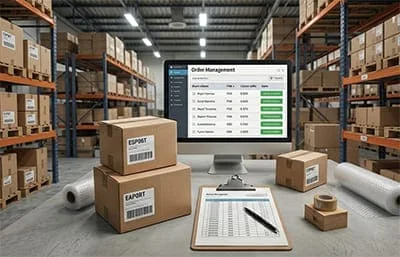
Streamline food service operations encompassing order management, table allocation, kitchen workflows, inventory consumption, and daily revenue reporting.
Secure corporate offices and controlled facilities with structured digital visitor registrations, organizing check-ins, and related front-desk workflows.
Our enterprise software development for growing organizations ensures that architectural planning considers data security, validations, reporting, and realistic long-term scaling.
Information moves from one stage to another (request → approval → purchase → delivery) according to defined business rules instead of manual file transfers.
Keep the system organized by giving users access to the functions relevant to their responsibilities. Sales needs CRM, finance needs payments.
Dashboards present sales, expenses, stock, and production indicators to help decision-makers understand the current state of the business.
Exchange information with existing applications, payment services, or hardware devices through compatible integrations for connected operations.
Validate information before it enters the database and maintain audit logs to know who created, changed, or approved important records.
Choose cloud hosting for multi-location access or local on-premise servers depending on security policy, internet availability, and IT resources.
Custom architecture, agile engineering, and continuous deployment synchronize seamlessly—accelerating digital innovation, lowering operational overhead, and delivering scalable enterprise ROI without technical debt.
Identify The Core Problem
Document Real Workflows
Establish Rules
& User Access
Develop Modules
& Interfaces
Conduct Rigorous System QA
Deploy
& Train Your Staff
Selecting a software partner is a long-term business decision. We focus on your practical business operations rather than arbitrary feature lists.
We ask how your company actually operates before discussing programming languages or drawing screens. Important business rules aren't missed.
From manufacturing ERPs to hospital management and POS systems, our past project catalog guarantees we understand your industry's specific metrics.
Before a project kicks off, we clarify complete terms regarding your database, accounts, hosting, and backup records to ensure zero disputes later.
We build architecture designed to safely accommodate higher transaction limits, multiple geographical branches, and increased reporting workloads.
Instead of forcing your processes into a fixed mold, we identify precisely which workflows, forms, and validation rules need dedicated custom configuration.
Software evolves as your business does. We offer robust maintenance packages for new modules, issue investigation, integration updates, and workflow changes.
Built-in event streaming pipelines broadcast instant webhook triggers, SMS alerts, push notices, and transactional emails across enterprise systems.
Empower field teams and end-users with native mobile applications designed for offline data synchronization, real-time collaboration, and biometric authentication.
Gain complete visibility over software ROI with dedicated business intelligence modules that track revenue run rates, infrastructure usage, and recurring operational costs.
Chief Technology Officer / Fintech Founder
Partnering with their custom software development team completely revamped our core transaction engine. Migrating away from rigid off-the-shelf tools to a high-throughput microservices architecture was flawless. Our automated API pipelines now process millions in daily volume with zero latency.
VP of Product / Enterprise SaaS Director
Their agile engineering expertise and technical discovery process gave us complete clarity from sprint zero. The custom multi-tenant architecture and CI/CD pipelines they implemented cut our feature release cycles in half. Their dedicated engineering team sets the gold standard for full-stack delivery.
Head of Digital Transformation / HealthTech CEO
The custom platform they engineered exceeded every strict regulatory and compliance benchmark we needed, including HIPAA and SOC 2. They modernized our legacy databases into an intuitive, secure cloud system that our operations team adopted effortlessly on day one.
Chief Operating Officer / Logistics Enterprise
We needed a tailor-made ERP solution to unify global supply chain tracking, automated invoicing, and real-time fleet analytics under one roof. Their custom software solution delivered precisely that, saving us thousands in recurring licensing overhead while scaling our operations seamlessly.
Enterprise-Grade Custom Software Engineering For Scalable Architecture, Workflow Automation, and Digital Transformation
A software development company plans, builds, tests, deploys and maintains software according to business or operational requirements. Depending on the project, this can include custom management systems, ERP, HR, accounting, POS, inventory, automation, integrations and specialized industry software.
Software development cost depends on the project scope, modules, number of users, business rules, database requirements, integrations, reports, deployment and support requirements. A custom quotation should therefore be prepared after the requirements are understood.
Custom software development means building or adapting a system around the specific workflow and requirements of an organization instead of requiring the organization to work exactly according to a generic ready-made product.
GCTL Infosys provides custom business software and solutions such as ERP, HR and payroll, accounting, POS, inventory, visitor management and other industry-specific management systems. Exact functionality depends on the selected solution and project scope.
Custom software may be appropriate when existing tools cannot support important workflows, when employees depend heavily on manual processes, when several disconnected systems need to work together or when the organization requires specialized reporting and automation.